!["The world don't need any more [blogs]" - Bob Dylan](https://substackcdn.com/image/fetch/$s_!XgRf!,w_120,h_120,c_fill,f_webp,q_auto:good,fl_progressive:steep/https%3A%2F%2Fsubstack-post-media.s3.amazonaws.com%2Fpublic%2Fimages%2F03b0176e-c109-450c-8c01-1b95678117da_1280x1280.png)
Gene Clark

Despite his immense talent, he’s not a household name like his fellow Byrd David Crosby, or even a cult figure like his contemporary Gram Parsons. Through my other Substack, I’ve sought to share why I think Gene’s music is so special, one song at a time. He’s an amalgamation of country, folk, surprising chord changes, unique acoustic rhythm guitar strumming, soulful harmonica, beautiful melodies, yearning and often opaque lyrics, and a gorgeous voice, both haunting and tender. To inspire you to check him out, the following are some lovely parallels between Bob and Gene, including their shared admiration for each other’s artistry.
They were both steeped in traditional music. Gene’s childhood friend Jack Godden recalled that Gene and his father would always be on the porch “playing Woody Guthrie-type songs”, and even before his brief stint in the New Christy Minstrels, he was part of a folk group called the Rum Runners. His affinity for traditional music never waned. Its influence can be heard on his songwriting throughout his career. Gene’s biographer John Einarson wrote, “Gene found himself drawn to the simple virtues of folk music… singing of the verdant fields of colonial America, Appalachian mining disasters, or Civil War glories.” That sounds just like Bob to me.
The way they sing their lyrics in conjunction with their music is central to why they move me the way that they do. I think of the words, music, and performance as a tripod. You can’t take any leg away, and when they come together for Gene and Bob, it’s in a way that is uniquely theirs. The Byrds manager Jim Dickinson captures what I think Bob and I are responding to in Gene’s songs. “We saw some value in Gene’s stuff, Dylan saw more… the thing that worked for Dylan was… the feeling that Gene gave a song… the words printed on paper without Gene’s phrasing made less sense.” Bob is not going to be bothered by things not making sense, and I never think too hard about what lyrics mean, only the way they make me feel when I hear them sung. I think in the mid 60s popular music scene, Bob saw in Gene a kindred spirit who didn’t feel the need to have everything be so cut and dry.
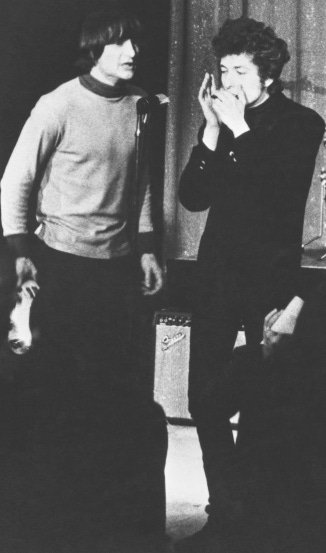
Jim Dickson said that Bob "recognized, even before I did, the quality that Gene had as a songwriter… Dylan understood the value of Gene Clark as a songwriter more profoundly than any of us.” Bob continued to champion Gene even after The Byrds, saying of his song “For a Spanish Guitar”, "something I or anybody else would have been proud to have written." According to Gene’s drummer Andy Kandanes, after their show at LA’s Troubadour in 1977, Bob came backstage and said “that was one of the best shows I’ve seen.” When Gene released his version of “Mr. Tambourine Man” in 1984, Andy Kandanes said Bob told Gene’s producer Tommy Kaye that he loved it, that it was one of the best versions he’d heard.
Bob was an enormous inspiration for Gene. He said that Bob “had a way of putting things down with all kinds of images to follow. Instead of just saying something in a plain and simple way he gave… places to go in your imagination… high-rolling poetry”. Along with John Lennon, Gene said that they are
Two of the best minds that we… have in the 20th century mainly because, in my opinion, they were able to transcend just good, common logic and knowledge and get into the fact that the world is in trouble. And they were getting something out that was making a statement about it and, in a way, point some kind of direction.
Bob said each line of “A Hard Rain’s a-Gonna Fall” could be its own song, and that’s exactly the kind of impact Bob had on Gene’s songwriting. Gene’s written fantastic songs like “Strength of Strings”, which is a lyric from Bob’s “Lay Down Your Weary Tune”. Gene’s “Gypsy Rider” sounds like its inspiration was from the line "The motorcycle black Madonna, two-wheeled gypsy queen" from Bob’s “Gates of Eden”.
Jimmi Seiter, someone who has worked in the music industry in various capacities for many artists, said of Gene:
He'd pick up a guitar and play and if one string was out of tune, he thought, 'OK, I'll live with that.' Gene didn't care whether he was in tune or not. It didn't matter to him - and that's the way Dylan was. They both liked to sit down and play whenever they felt like it.
In his 60 Minutes interview, Bob talks about how his songs from the 60s were almost magically written, and in a 1988 radio interview Gene described his gift as
An energy being channeled through you, but I don’t know what kind or where... I wake up and go wow there it is, and you know run out turn the tape recorder on pick up the guitar and play it... if I don’t catch it right away it goes away.
In Bob’s Nobel acceptance he says “songs are unlike literature. They’re meant to be sung, not read. The words in Shakespeare’s plays were meant to be acted on the stage. Just as lyrics in songs are meant to be sung, not read on a page.” According to Gene’s friend Dennis Kelley, Gene said “to sing those words is really where the beauty lies… to read the lines on paper is one thing, but to sing them really makes them come alive.”
I like to think Bob still believes in Gene’s greatness. That some day when he’s playing Missouri or Kansas, where Gene was born and raised, he’ll cover one of his songs. Perhaps Gene was even in his mind when he was writing The Philosophy of Modern Song. In Bob’s chapter on “Beyond the Sea” he writes:
The clipper ships, the schooners and sloops. Onwards and onwards you go sailing over the bounding main, and off into the wild blue yonder. Sailing towards your life-your final destination… You’ve been knocking about on this voyage since forever, riding on the crest of a high rippling wave, heading for a place you never heard of. You’re the skipper. Soon the fair winds blow you into the harbor, and you see the port lights.
The following is from Gene’s song “Silent Crusade”.
I am told that my life is a clipper
The sea of time has tossed about
And I know that there’s only one skipper
Who can guide that ship about
Seems my dreams are the wings of a spirit
This vessel sails can’t fill without
From its wind comes the light of inspiration
And the darkness of doubt
It’s probably just a coincidence with the shared words and imagery, but regardless, the feeling is the same. Two incredible artists, in search of their musical destiny.
Many thanks and appreciation to the late Byrds biographer Johnny Rogan for his exhaustive research and wonderful writing in Requiem for the Timeless, volumes 1 and 2, in which the above quotes appear.